 ABPN
ABPN

Continuing Certification (CC) Program
The ABPN has a continuing certification (CC) program and specific activity requirements.
As mandated by the American Board of Medical Specialties (ABMS), the Board has developed a CC program that includes the following components illustrated in the infographic below. Details on all CC Program components can be found here:
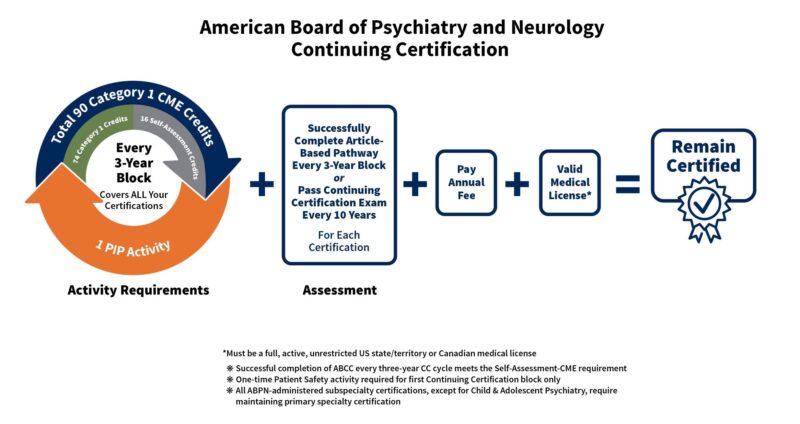
Continuing Certification program participation includes meeting all components of the CC Program. Diplomates are only required to complete one set of CC activity requirements (CME, SA and PIP activities) for all specialties/subspecialties in which a physician is certified. Continuing Certification (CC) activity credit (CME, Self-Assessment CME, PIP, and ABCC article exams) must be obtained within the designated time frame of a diplomate’s current three-year CC cycle. Excess credit during the current three-year cycle, or completed prior to this period, cannot be applied toward future CC Program requirements.
Certification in ABPN subspecialties (with the exception of child and adolescent psychiatry) are dependent upon the primary specialty. Diplomates must maintain certification in their specialty in order to maintain certification in the area of subspecialization. ABPN diplomates currently certified in a multidisciplinary subspecialty administered by an ABMS member board other than the ABPN (Brain Injury, Hospice and Palliative Medicine, Pain Medicine or Sleep Medicine) now have the option of following the lead of the administering ABMS member board regarding their primary certification requirement. See this page for more information.
Diplomates must sit for a CC examination at least once every 10 years for each certification they hold or participate in the Article-based Continuing Certification (ABCC) Pathway every 3-year CC cycle for each certification they hold.
Diplomates who do not meet all components of the CC program are no longer certified.
Diplomates are required to update their Clinical Activity Status information in their Portal account ‘Diplomates Information and Status” section.
All certificates issued from 2012 to the present do not have an expiration date as certification is dependent upon meeting all ongoing continuing certification program requirements (CME, Self-Assessment, PIP, licensure, fees, etc.). Without expiration dates on certificates, there is no reason to print additional certificates for diplomates who remain certified in good standing. Diplomates can visit their ABPN Physician Portal for free downloadable CC program status certificates. Verification letters are now available in the Physician Portal accounts.
The ABPN will always continue to issue certificates for initial certification and for diplomates who are pursuing re-entry after a lapse in certification.
View the ABPN Guide to CC and CC Booklet for more information.